
What Can a 4000W Inverter Generator Run?
Whether it’s dealing with sudden power outages caused by storms or preparing for off-grid outdoor activities on the weekend, a stable and reliable power supply is indispensable. The 4000-watt inverter generator combines light portability with strong output, making it an ideal choice for a mobile power source – it is not only easy to carry but also capable of supporting key household appliances and various outdoor equipment.
From home emergency backup power and RV power supply to outdoor construction operations, the 4000W inverter generator can provide comprehensive support for various scenarios. This guide will comprehensively explain the load capacity, power usage management techniques, and core advantages of generators in this power range.
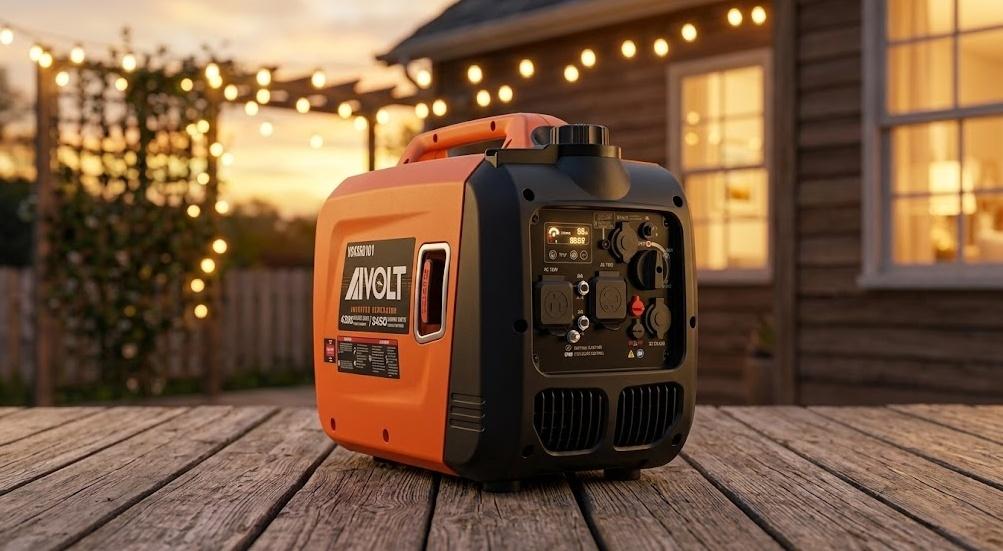
4000W Power Ratings: Running Watts vs. Starting Watts
To assess the load capacity of a 4000-watt generator, the key lies in understanding the power rating of the generator. Manufacturers typically use two key indicators to represent the generator’s output: running power and starting power.
- Operating power (rated power): This refers to the power required for the generator to provide continuous, safe power supply and maintain the normal operation of the equipment. For an inverter generator with a rated power of 4000 watts, its continuous operating power is typically between 3200 and 3500 watts.
- Starting power (peak power): Inductive load equipment (such as refrigerators, air conditioners, and power tools) requires a sudden high current when starting the compressor or motor. The starting power is the short-term surge power that the generator can withstand for a few seconds – in this specification, it is 4000 watts.
Why Inverter Technology Matters for Your Electronics
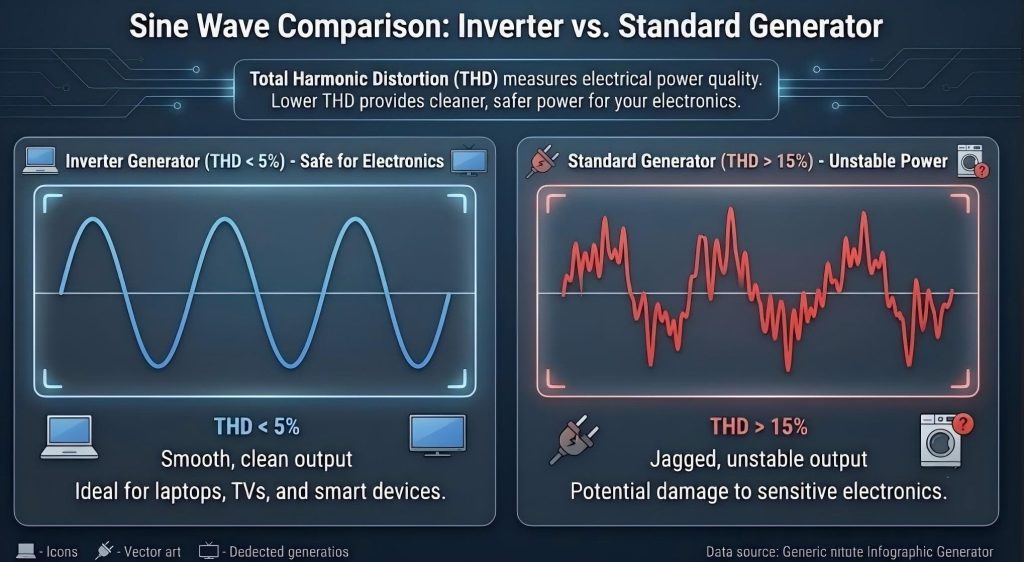
Not all generators produce power of the same quality. The “dirty power” generated by traditional open-loop generators typically has a high total harmonic distortion rate (THD), usually ranging from 12% to 20%. Such high-distortion power is highly likely to cause overheating of sensitive microprocessors in devices such as smartphones, laptops, smart TVs, and digital refrigerators, and even lead to permanent damage.
In contrast, the inverter generator employs an “AC-DC-AC” dual conversion technology to convert the original electrical energy into a pure sine wave. Its THD is lower than 5%, and it can output power that is as safe, stable, and clean as that from a standard power socket.
4000W Inverter Generator Appliance Power Chart
The table below outlines common household appliances, outdoor equipment, and power tools, detailing their typical running and starting wattages to help you plan your power usage.
| Application Category | Appliance / Tool | Approx. Running Watts | Approx. Starting Watts | 4000W Inverter Compatible? |
| Home Emergency | Residential Refrigerator / Freezer | 150W – 800W | 1200W – 2000W | ✅ Yes |
| Window Air Conditioner (10,000 BTU) | 1,000W – 1,200W | 1,800W – 2,200W | ✅ Yes | |
| Sump Pump (1/2 HP) | 1,050W | 2,150W | ✅ Yes | |
| Wi-Fi Router, Laptop, LED Lights | 200W Total | 200W Total | ✅ Yes | |
| RV & Boondocking | RV Air Conditioner (13,500 – 15,000 BTU) | 1,250W – 1,500W | 2,800W – 3,000W | ✅ Yes |
| Microwave Oven | 1,000W – 1,200W | 1,500W | ✅ Yes (Staggered use) | |
| Electric Coffee Maker | 1,000W – 1,500W | 1,500W | ✅ Yes | |
| Yard Care & DIY | Circular Saw | 1,200W – 1,400W | 2,300W | ✅ Yes |
| Air Compressor (1 HP) | 1,500W | 3,000W | ✅ Yes |
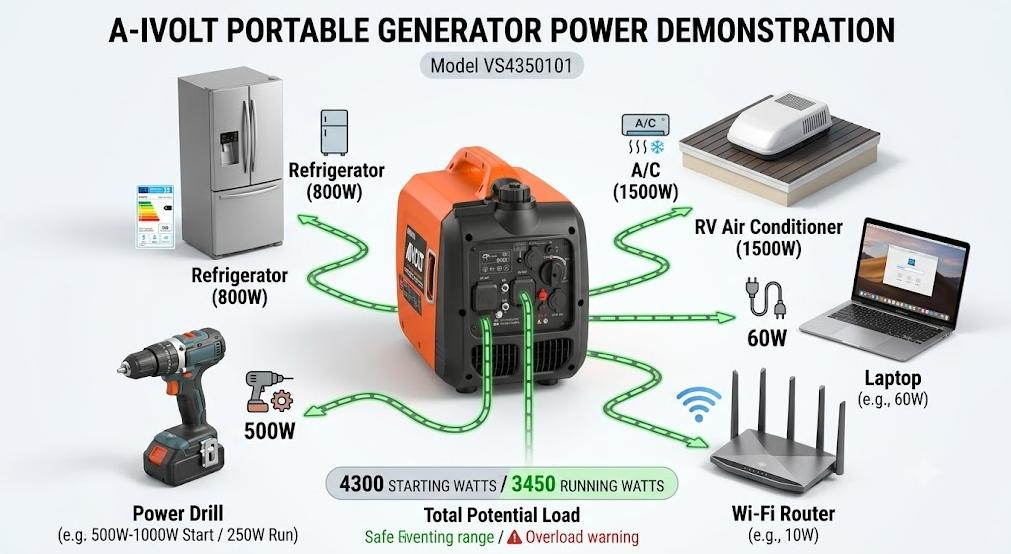
Real-World Power Scenarios: What Can You Run Together?
In practical use, generators are often required to supply power to multiple devices simultaneously. The following is the load performance of a 4000W inverter generator in a typical scenario:
Home Emergency Backup
In case of a sudden power outage, a 4000W inverter generator can easily meet the basic living and comfortable electricity demands of the household:
- Full-size refrigerator (operating power approximately 200W)
- Wi-Fi router and LED lighting (operating power approximately 150W)
- TV and laptop (operating power approximately 150W)
- 5000 BTU window air conditioner or floor fan (operating power approximately 500W)
Continuous total load: Approximately 1000W (significantly lower than the generator’s rated continuous power of 3200W – 3500W). This indicates that you still have ample power reserve to handle intermittent peak power consumption from devices such as microwave ovens or coffee machines at any time.
RV & Boondocking
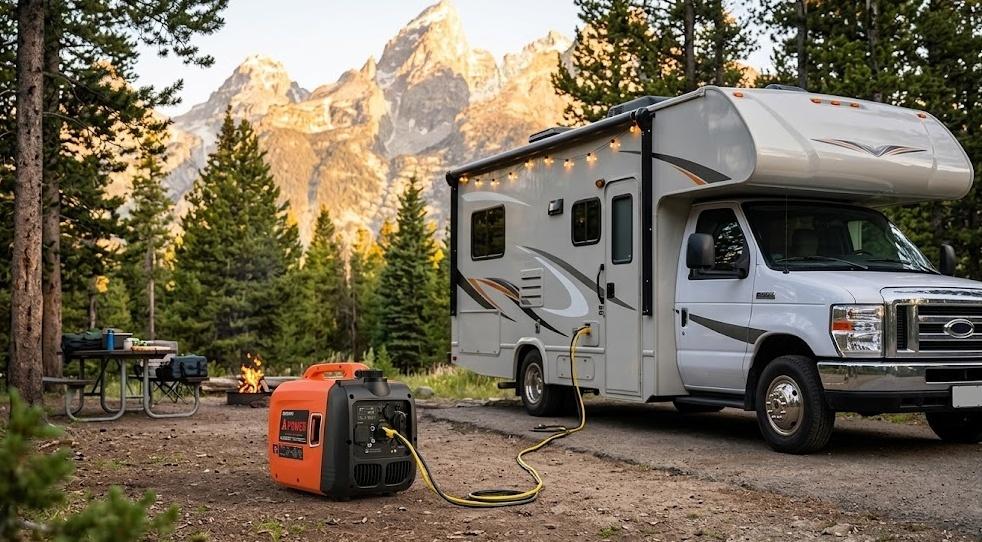
The off-grid caravan scenario has extremely high requirements for power load. A 4000W inverter generator can easily start and operate a caravan air conditioner with 13,500 BTU or 15,000 BTU (the peak startup power is approximately 2800W, and the rated operating power is approximately 1500W). While the air conditioner is running continuously, the generator can still provide about 1700W of reserve power to simultaneously ensure the daily power supply for onboard LED lighting, TV, and refrigerator.
Yard Care & DIY Projects
In outdoor crop maintenance and construction site operations, the 4000W inverter generator can provide immediate and stable power support. Even when simultaneously powering high-load electric tools such as 15-amp circular saws, electric drills, and halogen work lights, the system can maintain stable voltage and prevent voltage drop.
What CANNOT Run on a 4000W Inverter Generator?
The 4000-watt portable generator, though versatile, also has its performance limitations. It is unable to power heavy equipment that requires 240V power supply or high starting surge power, such as:
- Whole-house central air conditioning (with operating power ranging from 3000W to 5000W+)
- 240V electric drying machine and electric water heater (operating power 4500W – 5500W)
- Electric stove (operating power: 2000W – 5000W)
- Industrial-grade arc welding machine
High power demand solution:
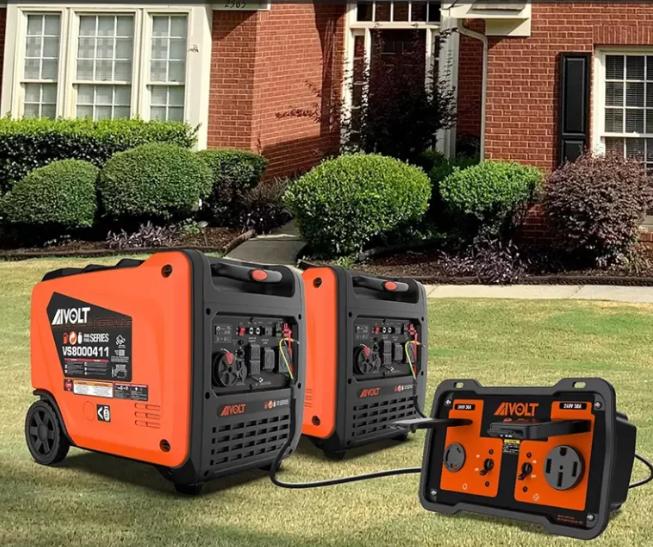
When the total power exceeds 4000 watts, there is no need to force the purchase of a bulky and noisy 8000-watt generator. By connecting two lightweight AIVOLT inverter generators through the AIVOLT parallel kit, the rated output power can be doubled while retaining the portability advantage.
3 Simple Steps to Calculate Your Power Needs
Before connecting the electrical devices, please refer to the following load calculation method to prevent the generator from overloading or the circuit breaker from tripping:
- List the necessary equipment: Count all the electrical devices that need to be running simultaneously.
- Calculate the operating power: Add up the rated operating power of all the devices to ensure the total is below the rated power of the generator (for example, 3300W).
- Summarize the maximum surge power: Identify the single device with the highest startup power (such as a refrigerator or air conditioner), and add its startup surge power to the total operating power. Ensure that the total peak demand does not exceed the maximum output power of the generator (for example, 4000W).
Why AIVOLT Inverter Generators Are the Ideal Choice for Portable Power
When choosing a portable generator, output performance, fuel economy, and operating noise are the three core indicators. From outdoor camping and construction sites to home emergency backup, the AIVOLT inverter generator can provide stable and efficient power support.
- High-quality power (THD < 5%): Utilizing advanced inverter technology, it outputs pure sine waves, fully ensuring the safe operation of smartphones, laptops, and precision household appliances, and preventing voltage fluctuations from damaging the equipment.
- Intelligent silent operation: Equipped with the intelligent Eco energy-saving mode, it can automatically adjust the engine speed according to the actual load, significantly reducing operating noise while improving fuel efficiency and ensuring a peaceful environment.
- Dual-machine parallel expansion: To meet the demand for high-power loads, simply connect the two AIVOLT generators through the parallel kit, and you can easily double the output power.
- Portable mobile design: Equipped with ergonomic handles and wear-resistant rollers, it can easily meet the mobility and deployment requirements of various sites.