
How to Pressure Wash a Wood Deck Without Damaging It
Every year, the same story plays out on driveways and decks across the country : someone rents or unboxes a pressure washer, points it straight at a gray, weathered deck, and then ends up with fuzzy, splintered wood instead of a clean surface. The good news is that pressure washing a wood deck is completely safe, it’s just that the issue is almost never the machine itself. It’s usually the PSI level, the nozzle choice, and the overall technique used while spraying. Below, we’ll cover the safe pressure range, which nozzle to pick, and a step-by-step flow that gets things clean without shredding the wood fibers underneath.
Can Pressure Washing Actually Damage a Wood Deck?
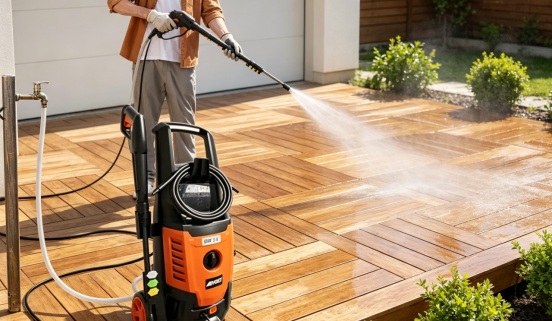
Yeah, it can, but it’s usually not the pressure washer itself, more like a couple of common missteps. Most of the time it boils down to one of these three issues: blasting it with too much pressure, keeping the nozzle too close, or grabbing a narrow-angle tip that was really meant for concrete, not wood. Once you go over roughly 2,500 PSI, you’re much more likely to strip stain or paint, and when you push pressure past 3,000 PSI, wood fibers can get permanently harmed, so the deck ends up harder to finish later. When you do it right, though, pressure washing is still one of the quickest and most efficient methods to clean a deck.
What PSI Is Safe for Pressure Washing a Wood Deck?
There isn’t one clean “correct” number, since the wood type really matters—but it’s still worth trying to split it into two parts. First, your machine’s max rated PSI, and second, the real force that is landing on the wood. That part depends way more on nozzle angle and how far you hold the wand than on the pump’s top spec. Softer woods like cedar and pine are kind of touchy, and they usually do best when the effective spray force lands somewhere around 500–800 PSI. Denser hardwoods tend to take a little more, though, so you can often creep upward a bit without doing too much damage. As a general rule, most decking — regardless of species — cleans effectively with a surface impact somewhere between 500 and 1,500 PSI. This is why a higher-rated machine like a 3000PSI unit isn’t automatically too powerful for a deck: paired with a wide 25° or 40° nozzle and held at the right distance, it disperses that same 3000PSI output across a much larger area, bringing the actual force on the wood well within a safe range. The mistake isn’t owning a high-PSI machine — it’s using the wrong nozzle or standing too close.
Choosing the Right Nozzle for Wood Surfaces
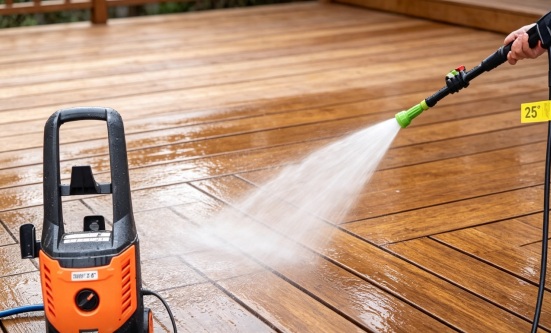
Nozzle angle affects wood just as much as PSI does. A 0° nozzle concentrates water into a pinpoint blast strong enough to etch concrete — never use it on wood. A 15° tip is also kind of narrow, so it usually isn’t a good fit for most decking. For wood siding, fences, and deck boards, go with a 25° nozzle (most times it is color-coded green) because it hits that sweet spot, wide enough to spread the force more evenly, yet still narrow enough to lift grime, mildew, and gunk without going too aggressive.
How to Pressure Wash a Wood Deck: Step-by-Step
Clear and sweep the deck first
Take out furniture, planters and rugs, then sweep up loose leaves, dust, little bits of debris. If you just pressure wash over that stuff, it tends to push grimy grit down into the wood grain, instead of actually lifting it away, which is kinda the opposite of what you want.
Test in an inconspicuous spot
Before you begin working across the entire deck, make sure you test the PSI and nozzle in the corner that is hidden or beneath the bench. If the wood is floppy or splits, or appears more slender than the surroundings you can lower the pressure before proceeding.
Keep the nozzle at the right distance and angle
Hold the nozzle about 12–18 inches from the surface, and spray following the wood grain direction. Don’t go straight down, and don’t spray across it either. Spraying against the grain is one of the quickest ways to raise fibers, and then you’ll end up with streak marks that you can see, later on.
Work in Overlapping Sections
Move in slow, steady, overlapping passes rather than lingering in one spot. Lingering too long in a single area — even at a safe PSI — can still wear a visible line into the wood over time.
Let the Deck Dry Before Walking or Staining
Once you’ve rinsed the whole surface, let it dry fully — typically 24 to 48 hours — before walking on it regularly or applying stain or sealant.
Common Mistakes That Damage Wood Decks
A lot of deck damage comes from a short list of little repeatable mishaps, like holding the nozzle too close, using a 0° or 15° tip instead of a 25° or 40° fan pattern, spraying straight into the wood grain, and pressure washing old boards that are softened or rotting, like they’re still solid. Skipping the test-patch step is another common one — what looks fine on sturdy boards can splinter instantly on a weathered or sun-damaged section just a few feet away.
How to Protect Your Deck After Pressure Washing
Cleaning is only half the task. After pressure washing, let the deck dry, fully, like actually wait until no dampness shows up anywhere. Then go back and look closely for spots where the wood looks raw , gray, or kind of stripped of its old finish—those areas are basically left exposed and they soak in moisture quicker than wood that’s properly sealed. Put on a fresh layer of deck stain or a sealant soon after cleaning, once everything is completely dry, and that helps block the wetness and cuts down the graying plus mildew growth that is what made you wash the deck in the first place.a lower initial price, a reliable dual fuel generator such as the AIVOLT 8000W can handle the vast majority of emergency situations without adding difficulty.
FAQ
A clean deck and a damaged one usually come down to the same two variables: PSI and nozzle choice. Staying in the safe range for your wood type, using a 25° nozzle, and keeping the spray moving with the grain will get you a genuinely clean deck without the splinters. If you’re shopping for a pressure washer that can handle this job alongside driveways, fences, and cars, the AIVOLT 3000PSI Electric Pressure Washer comes with five quick-connect nozzles — including the 25° tip built for wood and painted surfaces — so you’re not stuck guessing which setting is safe.