
Dual Fuel vs Tri Fuel Generators: Which One Fits Your Emergency Plan?
If you’re putting together a home emergency power system, you’ve likely come to the same crossroads that many homeowners encounter: Dual Fuel vs Tri Fuel Generator? Both offer flexibility in the event of an outage; however, they each solve somewhat different issues. We then break down the differences between them and back the choices with actual information, and enable you to determine which option is best suited to your specific situation- not just the specs sheet.
What Is a Dual Fuel Generator?
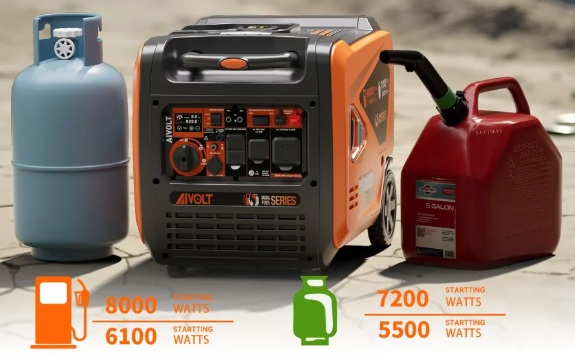
Dual fuel generators are able to run on propane or gasoline, and switch between both without the need for separate equipment. AIVOLT the 8000W Dual Fuel Inverter Generator is an excellent example of this: it makes use of automated fuel switching technology to switch between propane and gasoline in a seamless manner, delivering 8,000W of boost power and 6,100W running watts, while operating at just 62 dBA- less noisy than a standard dishwasher.
The core value of dual fuel is redundancy. If gasoline is scarce or your propane tank runs dry, you have a second fuel source on hand. But both fuels still share one limitation: you have to store them in advance. Gasoline degrades over time, and propane tanks eventually empty — meaning your runtime is only as long as your stockpile.
What Is a Tri Fuel Generator?
A tri fuel generator adds a third option on top of gasoline and propane: natural gas, delivered directly through your home’s gas line. This is the feature that changes the math entirely. As long as your natural gas service stays connected, you’re not limited by whatever fuel you happened to store beforehand.
Natural gas has a genuine reliability advantage worth understanding: pipelines are buried underground, which shields them from the wind, ice, and falling trees that typically knock out above-ground power lines. Natural gas infrastructure also benefits from what engineers call “line pack” — the pressurized gas already sitting in pipeline sections acts as a buffer that can maintain supply for days even if upstream pumping is briefly disrupted, according to industry infrastructure analysis from Liyu Power. That’s part of why natural gas service in parts of the Northeast reportedly continued uninterrupted during Hurricane Irene in 2011, even as millions lost electricity.
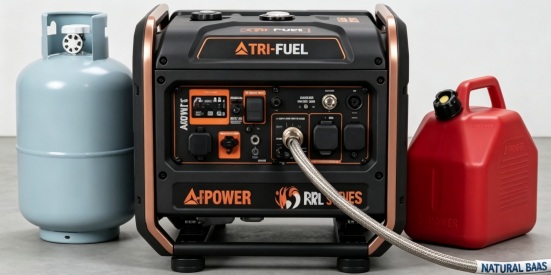
The tradeoff: tri fuel systems are more complex, typically cost more upfront, and only make sense if your home actually has a natural gas hookup to begin with.
Dual Fuel vs Tri Fuel: Side-by-Side Comparison
| Factor | Dual Fuel | Tri Fuel |
| Fuel options | Gasoline + Propane | Gasoline + Propane + Natural Gas |
| Fuel storage required | Yes, for both fuels | No, for natural gas |
| Upfront cost | Lower | Typically higher |
| System complexity | Simpler | More complex (extra fuel line) |
| Best for | RVs, off-grid homes, portability | Homes with existing gas line hookup |
| Output on natural gas | N/A | Often 10–20% lower than gasoline rating |
That last row matters more than most buyers realize. Running a generator on natural gas typically causes “derating” — a drop in peak output compared to running on gasoline, since natural gas has a lower energy density per unit of fuel. A generator rated for 10,000W on gasoline might only sustain around 8,000W on natural gas, according to generator efficiency analysis from Liyu Power. If you’re counting on a tri fuel unit’s full rated wattage while running on natural gas, plan for that gap.
Which One Fits Your Emergency Plan?
The right choice depends less on which generator is “better” and more on your specific circumstances:
If your home already has a natural gas hookup, a tri fuel generator is genuinely worth the extra cost. You get a fuel source that doesn’t run out mid-outage and doesn’t require you to remember to keep tanks full.
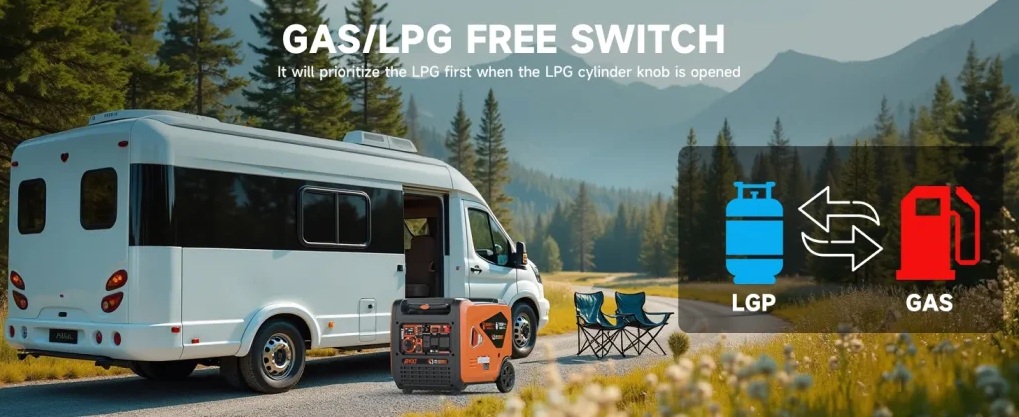
If you’re portable, off-grid, or don’t have gas service — RV owners, campers, or homes without a gas line — tri fuel’s signature feature is simply unavailable to you, making dual fuel the more practical and cost-effective choice.
If you’re mainly planning for short-duration outages, the math shifts further in dual fuel’s favor. According to the U.S. Energy Information Administration, the average U.S. utility customer experienced just under two hours of non-storm-related outages in 2023 — well within what a dual fuel unit like the AIVOLT 8000W can comfortably cover, given its rated 10+ hours of runtime at 25% load.
It’s also worth remembering that fuel type doesn’t determine raw power output — engine design and wattage rating do. A well-built dual fuel generator with a 322cc engine and copper windings, like the AIVOLT 8000W, isn’t underpowered simply because it lacks a third fuel option. Tri fuel adds flexibility, not necessarily more watts.
Don’t Overlook These Safety and Reliability Factors
Whichever type you choose, a few features matter just as much as fuel flexibility:
- Clean power output. A pure sine wave with low total harmonic distortion (THD) — AIVOLT’s 8000W model rates under 3% THD — protects sensitive electronics like laptops, phones, and medical devices from damage.
- CO shutdown protection. Automatic carbon monoxide detection and shutdown prevents a serious safety hazard that fuel type alone won’t address.
- Extreme temperature tolerance. A generator rated to operate from -4°F to 140°F ensures it starts reliably whether you’re facing a winter storm or a summer heatwave.
There’s no universal winner here — only the option that matches your home’s infrastructure and your outage risk. If you have a gas line and want the ultimate long-outage insurance, tri fuel earns its price tag. If you’re interested in the simplicity, portability and a lower initial price, a reliable dual fuel generator such as the AIVOLT 8000W can handle the vast majority of emergency situations without adding difficulty.