
How 5000 PSI Electric Pressure Washer Improve Your Spring Surface Restoration Efficiency?
For commercial contractors and facility management teams, the restoration of surfaces in the spring is a race against time and the effects of oxidation. After four months of exposure to corrosive winter maintenance salts and freezing temperatures, industrial concrete and heavy-duty steel need more than just an ordinary wash. They need a high-velocity mechanical stripping.
In the 2026 regulatory environment, the challenge is doubling: you need the PSI impact force traditionally found in gas units, but without the exhaust emissions and maintenance overhead that restrict indoor or noise-sensitive operation.
The solution is found with the 5000 PSI electric machine, providing high-torque induction power to the pump to clean away winter contaminants in one pass, rather than requiring multiple chemical treatments.
High-Pressure Impact on Spring Restoration Workflows
Spring restoration projects are vastly different from regular maintenance operations. After the winter cycle, the outdoor surfaces, especially industrial concrete, heavy machinery, and masonry, are usually coated with a mixture of hard mineral deposits, deep-seated molds, and oxidized paint. The process of cleaning these surfaces requires the breaking of the molecular bond between the dirt and the surface, and the regular 2000-3000 PSI equipment is usually not sufficient.
The physics behind the efficiency of cleaning is based on the impact force, which is measured in square inches. When the pressure limit reaches 5000 PSI, the water stream becomes a mechanical stripping agent rather than a rinsing agent. To restoration workers, this means the difference between a “multi-pass, chemical-intensive approach” and a “single-pass mechanical cleaning approach.” By using a 5000 PSI electric system, workers can avoid the “soak and scrub” approach, going directly to high-pressure removal, which cuts the project timeline in half.
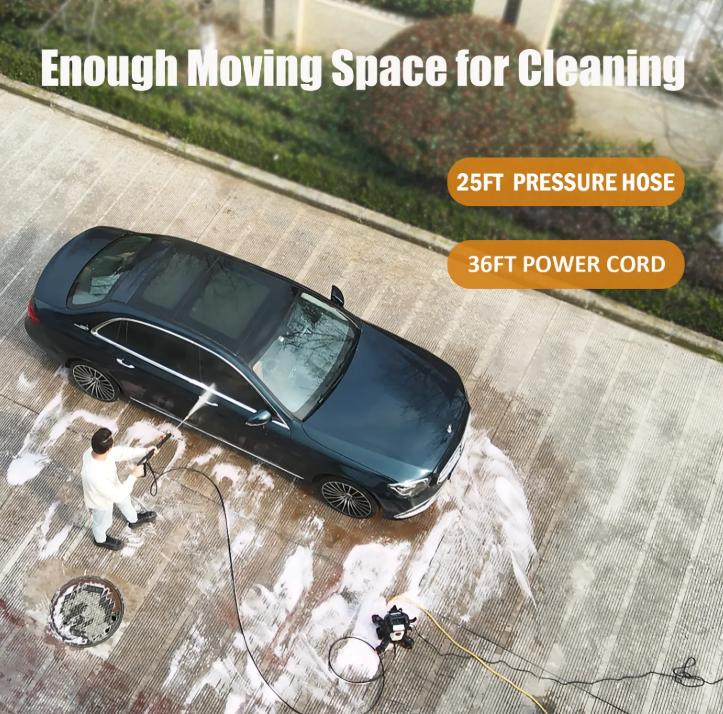
Quantitative Efficiency Gains of 5000 PSI Systems
In industrial cleaning, efficiency is defined in terms of “Cleaning Units,” or pressure multiplied by flow rate. A 5000 PSI unit provides an output of kinetic energy that enables an infinitely greater clean path without compromising the ability to remove stubborn coatings.
The following technical comparison demonstrates the difference in efficiency between an entry-level commercial machine and an industrial electric high-pressure machine:
| Parameter | Standard Electric (2000 PSI) | AIVOLT Industrial (5000 PSI) | Efficiency Gain |
| Stripping Capability | Light surface dirt | Heavy oxidation & old paint | 250% Higher |
| Time per 100 m² | ~4-5 Hours | ~1.5-2 Hours | 60% Time Saving |
| Water Consumption | 8-10 GPM (multiple passes) | 4-5 GPM (single pass) | 50% Reduction |
| Surface Impact Force | 12.5 Newtons | 31.2 Newtons | 150% Increase |
If the pressure is increased to 5000 PSI, less emphasis is placed on the volume of water. The high-velocity droplets will have more impact upon hitting the dirt, thus atomizing it instantly. This leads to less runoff and a cleaner work site, especially on projects with stringent environmental drainage regulations.
Engineering Advantages of Electric Over Gas for Spring Maintenance
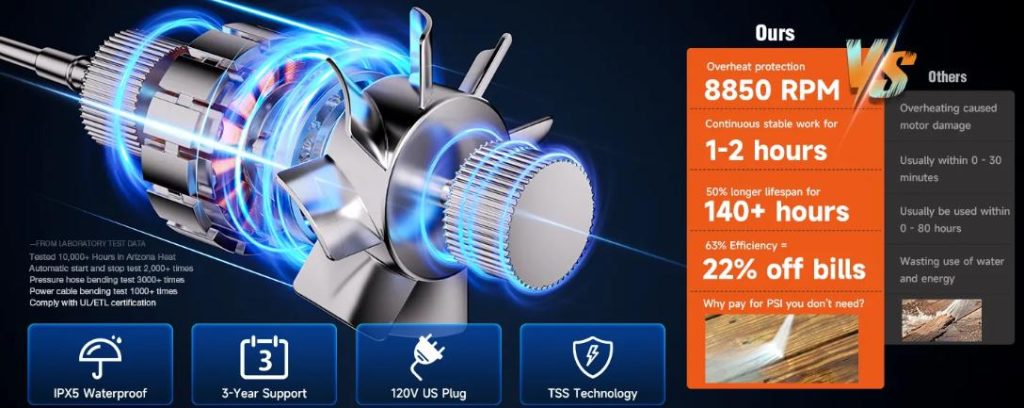
Although gas-powered washers have been the norm in high-pressure washer applications, the 2026 engineering world is moving towards high-torque electric induction motors. The move to 5000 PSI electric washers provides unique operational benefits, especially during the spring season when the weather is unstable.
- Instant Torque & Zero Priming: Gas engines have difficulties starting in early spring weather conditions. An electric induction motor provides 100% torque the instant the trigger is pulled. There is no need to prime the carburetor, stabilize the fuel, or maintain the spark plugs.
- Operational Consistency: The electric motor always spins at a constant RPM regardless of the load. This guarantees a constant PSI, which is crucial for surface restoration since inconsistent pressure can cause “zebra stripes” on the substrate.
- Indoor/Semi-Enclosed Capability: Many parking garages, warehouses, and residential areas have alcoves where spring restoration is done. The zero-emission electric motor allows for work in areas where gas exhaust would be hazardous, thus eliminating costly ventilation systems.
Application Scenarios in Professional Property Restoration
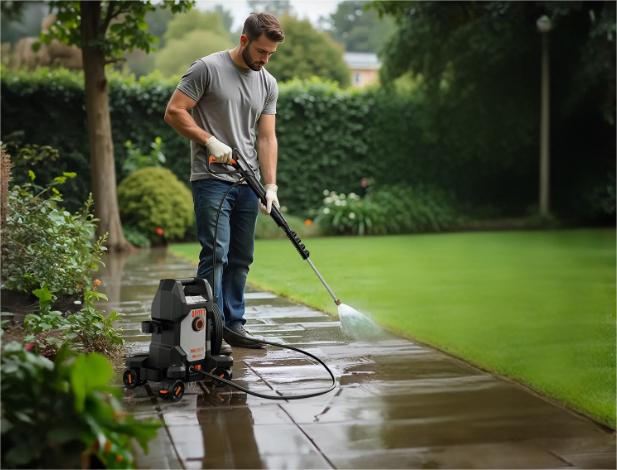
The 5000 PSI is the desired specification for three main types of restoration:
Substrate Preparation for Coating
In order to apply new industrial sealants and/or epoxies, the surface must first be “profiled.” The 5000 PSI water stream effectively removes all efflorescence and loose particulate matter, giving the surface a microscopic “pore open” texture. This guarantees the maximum adhesion of the new coating, avoiding early peeling and/or bubbling.
Deep Porous Cleaning of Masonry
Concrete and brick are porous materials. Chemical de-icers and salt crystals accumulate inside these pores during winter. Normal pressure cleaning only cleans the surface, and salt crystals remain inside, causing “spalling” or chipping of the surface. 5000 PSI has enough pressure to clean these salt crystals from inside the structure of concrete and brick materials.
Heavy Equipment De-greasing
Spring is the season when construction equipment and farming equipment return to service. The pressure output of 5000 PSI, coupled with a turbo nozzle, can remove hardened grease and “track clay” from excavators and farming equipment much faster than chemical degreasers.
Technical Selection Guide for Restoration Professionals
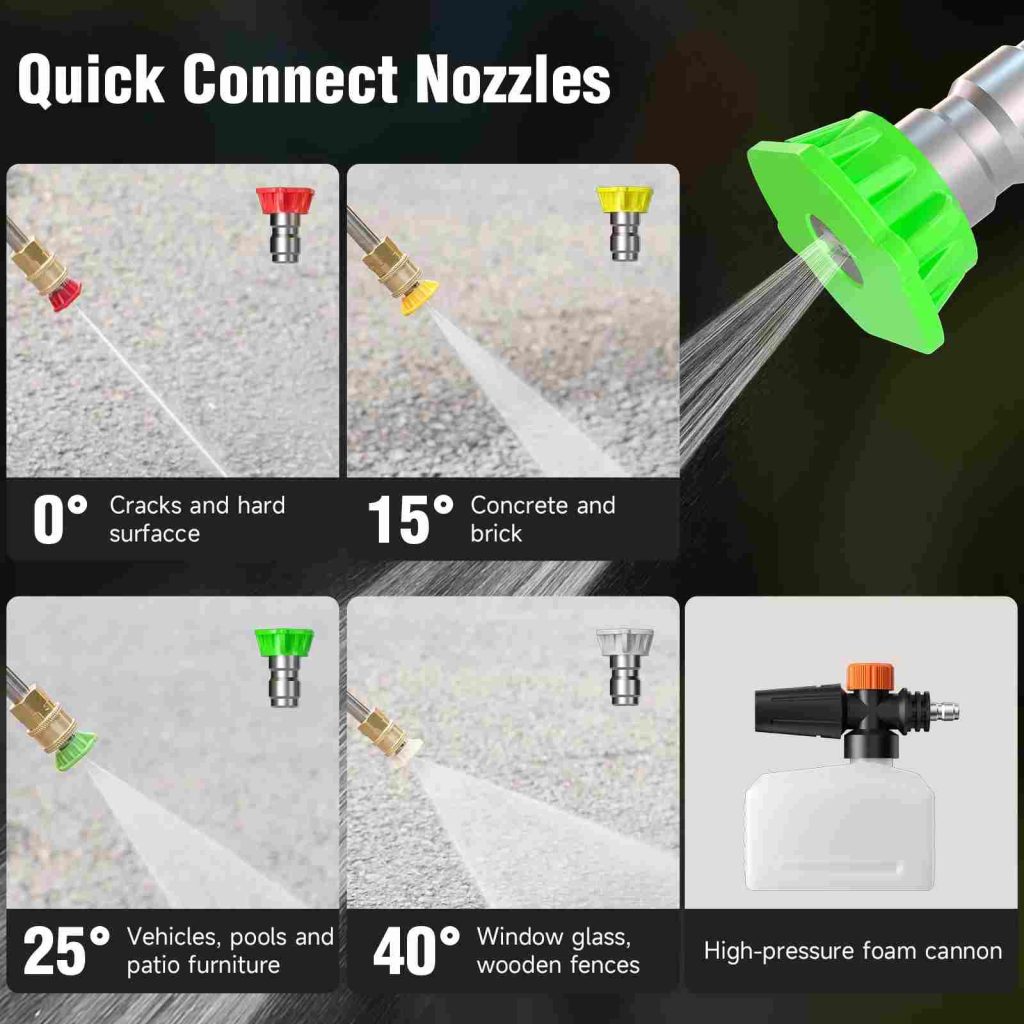
In order to obtain maximum output from the 5000 PSI, nozzle selection must match the Vickers hardness of the material and the removal rate desired.
- 0° Red Nozzle: This nozzle is used for heavy-duty spot stripping on steel or unpainted concrete. It provides the maximum impact force but covers the smallest area.
- 15° Yellow Nozzle: This nozzle is considered the “workhorse” for restoration jobs. Ideal for stripping paint or removing heavy oxidation from metal and masonry.
- 25° Green Nozzle: This nozzle is recommended for surface preparation jobs, when a large surface area needs to be cleaned quickly without damaging the underlying structure.
- Turbo/Rotary Nozzle: This nozzle is considered the most efficient nozzle for use in spring restoration, rotating a 0° stream in a circular pattern, allowing for maximum stripping power like a 0° nozzle and maximum coverage like a 25° nozzle.
Final
For the 2026 spring restoration, a move to a 5000 PSI electric system is a strategic move to high-velocity mechanical stripping. This is because doubling the impact force of standard units means that professionals can reduce labor time by 60%, eliminating cold start delays and emission limitations that are possible with gas engines.
The AIVOLT 5000 PSI electric pressure washer is designed to meet this high-velocity demand, with heavy-duty induction motors and precision-machined pump heads for 100% duty-cycle operation on concrete, steel, and masonry.
Equip your team with the 5000 PSI electric pressure washer and cut your restoration time in half—visit our product page for full technical specifications!