
Demystifying GPM and PSI for Your Electric Pressure Washer
People shopping for an electric pressure washer generally base their purchase decision on whether a machine will be able to “clean well.” However, actual cleaning capability relies on two key specifications: the Pressure per Square Inch (PSI) and the Gallons per Minute (GPM). These numbers are often placed on the product label, but most buyers aren’t quite sure how they translate into real-world results.
The interrelation between electric pressure washer PSI and GPM is such that understanding it will be the key to choosing a model right for your home tasks and to avoid the very common mistake of buying a unit that is powerful on paper but performs poorly in practice.
Let’s break these metrics down in a practical, customer-focused way.
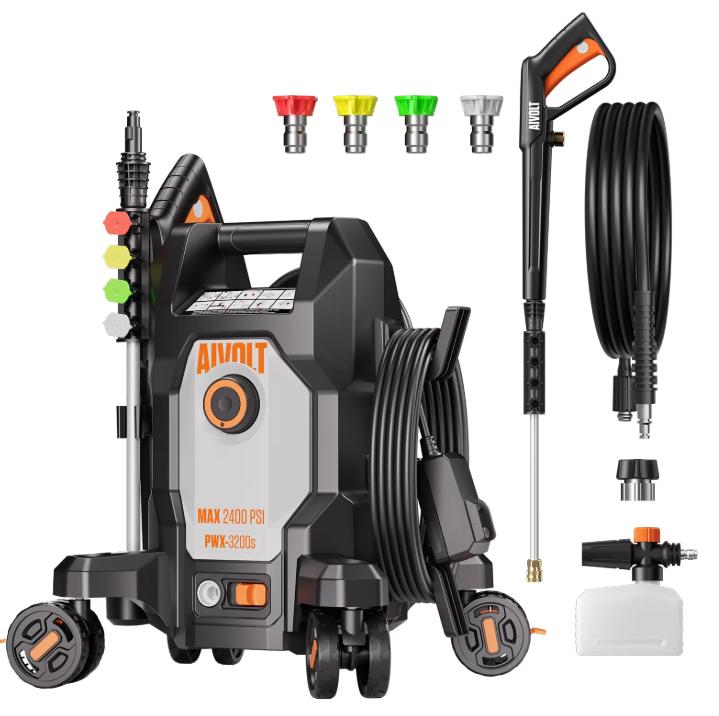
What is GPM vs. PSI in Electric Pressure Washers?
Every electric pressure washer lists the PSI and GPM, but they represent different strengths altogether:
- PSI (Pounds per Square Inch) = the force or impact of the water stream
- GPM(Gallons per Minute): Gallons per Minute, the amount of water the machine lets out in one minute.
Taken together, they determine cleaning power. You can think of PSI as the “strength” to break apart dirt, while GPM is the “volume” that washes debris away.
This is because a machine can have high PSI but extremely low GPM; it will blast off dirt but take forever to rinse. On the other hand, having high GPM with low PSI will not create enough force to stir stubborn grime in the first place.
Your decision to choose the right electric pressure washer for your needs will be founded upon understanding the balance between the two.
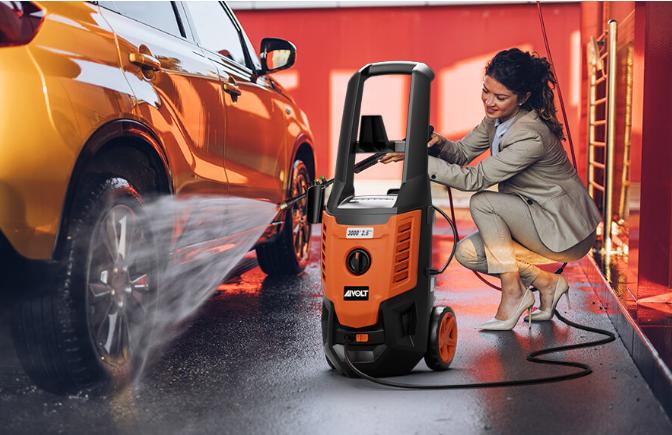
PSI in Electric Pressure Washer: Why it Matters for Cleaning Efficiency
While GPM influences how fast you can clean, PSI is the measure of strength behind every blast of water. Electric pressure washer PSI is the force that breaks up dirt, algae, mildew, and all the other contaminants that have bonded to a surface over time. Without adequate PSI, water may rinse dust away, but struggle against anything more stubborn.
What do Different PSI Levels Mean in Real Use?
While GPM influences how fast you can clean, PSI is the measure of strength behind every blast of water. Electric pressure washer PSI represents the force that breaks apart dirt, algae, mildew, and other contaminants that have bonded to a surface over time. Without adequate PSI, the water may rinse dust away but struggle against anything more stubborn.
What Different PSI Levels Mean in Real Use
Understanding the ranges of PSI helps you select an appropriate level of pressure for your cleaning tasks.
- 1500–1800 PSI: For vehicle detailing, patio furniture, bicycles, and other delicate surfaces.
- 1800–2200 PSI: A practical range for siding, composite decks, fences, and general household cleaning.
- 2200+ PSI: Some higher-end electric or prosumer models are best for deep-set stains, concrete, brick, and other hard surfaces.
These ranges spotlight one important fact: the “best” electric pressure washer PSI completely depends on what you plan to clean.
Why More PSI Isn’t Always Better
There is this bumptious illusion that the higher PSI, the better cleaning. On the contrary, too high pressure can be adverse—sometimes even destructive. For instance:
- High-PSI can lift or strip vehicle paint.
- On wood, too much pressure can result in gouges on the surface or raise wood fibers.
- A stream that is too strong for vinyl and soft materials causes warping or even holes.
That is why it is more about selecting an electric pressure washer based on having the “right” PSI rather than selecting one with the largest number. It’s controlled, effective cleaning you want, rather than brute force.

GPM in Electric Pressure Washer: How Much Pressure Do You Really Need?
When comparing electric pressure washers, GPM (Gallons per Minute) is an oft-overlooked feature, but it’s actually a huge factor in speed and ease when cleaning.
Why GPM Matters: Speed, Coverage, and Efficiency
A higher GPM means you can cover more ground with each pass, which becomes especially important when cleaning large areas or those that are highly soiled.
Typical GPM ranges include:
- 1.2 GPM: Suitable for general household tasks and light, occasional cleaning
- 1.5–1.8 GPM: A perfect fit for patios, fences, decks, and more frequent use
- 2.0+ GPM: Faster and more efficient, though less common in standard electric models
A small increase in GPM can reduce cleaning time dramatically. For this reason, many professional users consider GPM as important as, or even more than, PSI.
Why Pressure Alone Isn’t Enough
Many buyers think that PSI is the sole performance factor, but without adequate water flow, even powerful pressure feels slow and unsatisfying. If GPM is too low:
- You spend more time rinsing each section.
- Dirt may smear instead of washing away
- Cleaning large areas may become tiresome and inefficient.
In other words, GPM tells you how much work you need to do to complete the job. A balanced electric pressure washer with solid PSI and strong GPM will always clean more smoothly and quickly compared to a high-PSI machine with weak flow.
GPM vs. PSI? Which is More Important?
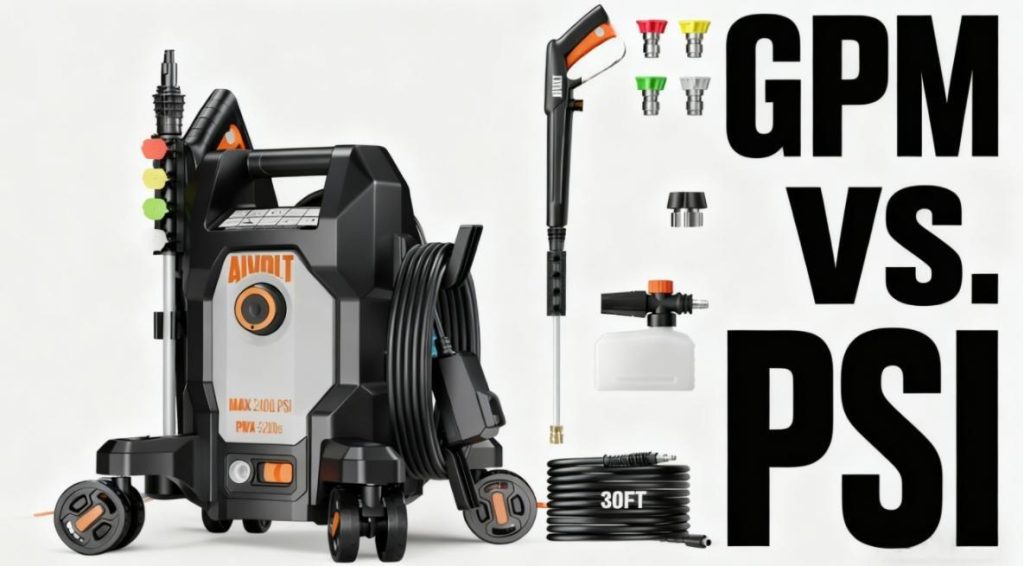
And when it comes to an electric pressure washer, most buyers have a single, straightforward question: GPM or PSI-which one is more important?
The truth is that each metric influences a different part of the cleaning process, and their importance depends entirely on what you’re trying to clean.
- PSI will tell if the stream of water is forceful enough to break up tough grime, mold, or stains that have bonded to something. If you’re cleaning older concrete marks, oily driveway spots, or really stubborn mildew, a higher PSI will make it a lot easier.
- GPM, on the other hand, influences how quickly you can rinse away everything that PSI has loosened. A higher electric pressure washer GPM means faster coverage, fewer passes, and noticeably better efficiency on large surfaces like decks, patios, and long sidewalks.
To get the best overall performance, one needs to see the interaction of PSI and GPM. A well-balanced electric pressure washer, not necessarily one with the highest numbers, will be able to deliver good real-world results.
Summary
Once you understand how PSI and GPM work together, choosing the right electric pressure washer becomes much easier.
- PSI determines whether or not the washer can break up stubborn grime.
- GPM determines how fast you can rinse and how efficiently you can clean larger areas.
- Cleaning Units (PSI × GPM) give a more complete picture of actual cleaning performance.
Rather than chasing the highest PSI, seek out the right balance for your tasks. With a proper understanding of electric pressure washer PSI and electric pressure washer GPM, you’ll be able to confidently make an informed purchase-one that truly matches your cleaning needs.
Want an electric pressure washer that’s reliable? Browse our range now on: AIVOLT Electric Pressure Washers