
Guide to Buy Portable Inverter Generator: Ventilation and High-Temperature Reliability
The summer months are known to be the best time for selling portable inverter generators. Yet, they also constitute the peak time for the breakdown of machines. Whereas conventional open generators endure high temperatures owing to their openness, the totally enclosed nature of the modern portable generator presents a classic case of thermal management.
In considering the purchase of inventory for hot climates, you can no longer solely consider the rated watts and pricing. Instead, you need to look at the specifications of the product and whether it will withstand the heat during the summer months.
The Hidden Cost of Summer Heat on Portable Inverters
High summer heat influences the operation of the inverter generator by means of mechanical and electrical failures.
Physics of Power Derating
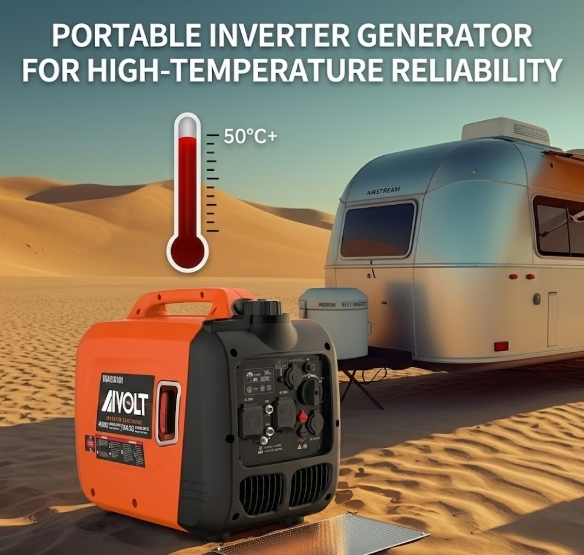
In environments warmer than 40 degrees Celsius (104 degrees Fahrenheit), air becomes considerably less dense. The internal combustion engine uses mass airflow to deliver an ideal air-fuel ratio. Hotter and denser intake air results in incomplete combustion, causing power derating.
A rough estimate is that any ordinary portable generator loses around 1%-1.5% of its output capacity for each 5.5 degrees Centigrade (10 degrees Fahrenheit) above the temperature of 15.6 degrees Centigrade (60 degrees Fahrenheit). Therefore, an average generator running in the summer at temperatures of 40 degrees Celsius in a desert or the Midwest will be able to produce up to only 1,700W of power, in case of its nominal value of 2,000W. Overloading your customers’ devices according to their nominal winter rating will cause them to fail frequently due to voltage drops or even stall altogether.
Stagnation of Heat within the Inverter Module
Unlike the conventional generator, in which energy is converted into raw AC energy by the alternator, the inverter generator converts the energy into DC power before transforming it into clean and constant sine waves. The inverter module depends on the use of micro-processors and IGBTs.
IGBTs experience high levels of localized heat during their use. If low-cost products are used, whereby the internal cabinet does not provide any form of thermal dissipation, the internal ambient temperature can easily exceed 70 degrees centigrade (158 degrees Fahrenheit). Once this temperature is exceeded, the control board initiates a thermal trip process. This has direct lost revenue and operational downtime for a business owner who uses the generator to operate his/her mobile workstation or food truck.
What to Look For Before Buying Portable Inverter Generator?
To guarantee consistent reliability all year round, don’t rely on what’s on the outside. Rather, take a deeper look and analyze three particular design features in detail when evaluating your chosen samples.
1. The Airflow Route
The first design feature relates to the air flow path, which can be poorly planned in a substandard inverter generator. A good one should include a completely isolated and unidirectional airflow cooling passage design.
While looking into the internal components of a generator, make sure that the air intake grille is as far as possible from the engine muffler. The most appropriate design would require that the air enter the generator via a special vent located at a distance from the engine, then flows along the following route: inverter – engine block – alternator – muffler shroud. Otherwise, your generator will overheat after just some time of constant operation.
2. Grille & Louvre Design
The ventilation system should be engineered to fulfill two contradictory requirements: to have the highest amount of airflow possible while also ensuring a sufficient Ingress Protection (IP) rating.
The louvres of the unit should feature a stampede geometric design that slopes downward. Such a design ensures that the system is protected from the radiant heat from the sun, protects the unit from vertical precipitation, and provides the maximum amount of net free area (NFA). One should avoid units featuring only a decorative mesh intake since such intakes will reduce the airflow and attract dust particles.
3. Internal Fan Optimization
As portable generators are designed to operate in varying engine speeds according to load requirements (also known as eco-mode or smart-throttle), a regular cooling fan could turn out to be an undesirable asset. With no significant load placed on the generator, its engine will have to work at low RPM. But the temperature inside the generator’s body will be high, which is why the electronic components need cooling.
High-end generators manage this task thanks to the optimized design of their internal fan blades, capable of creating enough static pressure. Examine the fan blade assembly during the disassembly of the generator: note that the blades need to have an appropriate aerodynamic shape.
Material Science Behind High-Temperature Reliability
Reliability under the sun is strongly influenced by raw material quality. Chemical composition is responsible for a generator’s capacity to survive a season of operation or to deteriorate quickly.
| Component / Feature | Low-Cost Standard | Premium Commercial Standard |
| Housing Polymer | Recycled ABS / Standard PP | UV-Stabilized PC+ABS Resin Alloy |
| Inverter Encapsulation | Low-grade Epoxy Resin | High-Thermal-Conductivity Silicone Potting |
| Summer Oil Compatibility | Strict 10W-30 restriction | Multi-grade 15W-40 / Synthetic 5W-30 support |
| Thermal Protection | Basic bi-metal thermal switch | Digital NTC Thermistor Network with MCU logic |
Case Polymers: Long-term exposure to UV light and internal overheating results in plastic warping or brittleness. Quality generators employ UV-resistant PC+ABS blend polymers. These materials are capable of resisting both deformation caused by temperatures above 100°C and impact damage that could affect latch and access panels under stress.
Inverter Potting Compounds: Electronic components located within the inverter have to be protected from moisture and mechanical vibrations. While low-quality epoxy potting compounds retain internal heat, high-quality modules use highly heat-conductive silicone potting materials that provide an efficient heat transfer between internal transistors and the aluminum heatsink blades.
3 Questions to Ask Your Inverter Generator Manufacturer
Before placing your bulk order request, ask these three technical questions to the engineering department of the manufacturing company to confirm that it can withstand high temperatures:
1. Will you share your test report for the High Temperature Environmental Chamber Test?
An authorized manufacturing company must provide an official test report confirming that it can run continuously for up to 500 hours in a closed chamber at around 45 degrees Centigrade.
2. What is the THD measurement when fully loaded beyond 40 degrees centigrade?
When inverter components get heated, they lose electrical efficiency and can generate electrical noise. It’s vital to know that the THD remains below 3 percent while maintaining optimal efficiency, even at high temperatures.
3. How does the circuit handle a thermal overload as compared to an electrical overload?
Simple generators automatically shut off power whenever they become too hot. Sophisticated microcontroller technology uses the Negative Temperature Coefficient (NTC) thermistor sensor to monitor gradual heating, alerting you via a warning LED or reduced output.