
Can an Electric Pressure Washer Really Clean a Driveway?
Yeah, an electric pressure washer can clean a driveway. But here’s the catch — it depends on how trashed your driveway is.
Light dirt, mildew, tire marks? No problem. A 2000 PSI electric unit handles that fine.
Old oil stains that have been sitting for years? That’s a different story. You’ll need degreaser, a brush, and probably two rounds. But that’s not the machine’s fault — those stains are just stubborn.
Gas washers are faster. No argument there. But for a normal driveway that gets cleaned twice a year? Electric is enough. And way less hassle.
This blog covers what PSI you actually need, which nozzle won’t mess up your concrete, and step‑by‑step instructions that work.
Comparing Gas vs. Electric Pressure Washers for Driveways
This isn’t about which is “better.” It’s about which fits your driveway and your tolerance for maintenance.
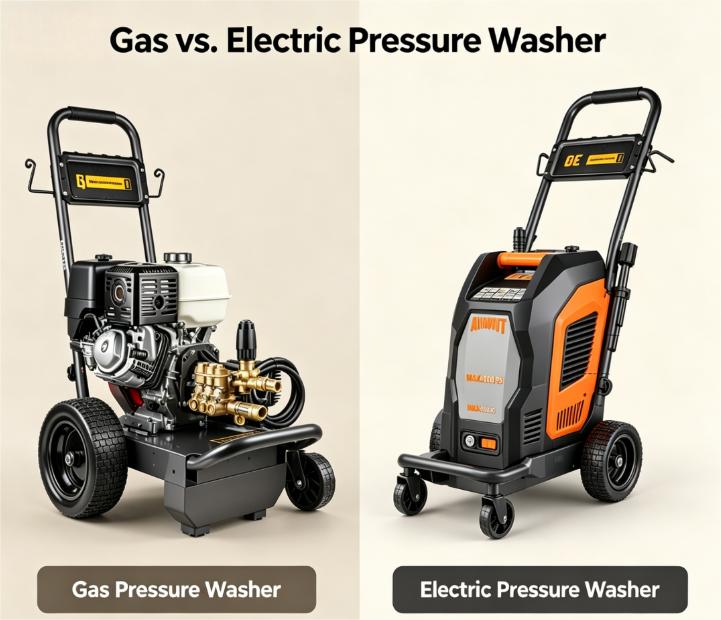
Electric pressure washers
Plug in and start. No oil changes, no stale fuel, no carburetor cleaning.
Quieter. You can use them in a neighborhood without feeling like a runway crew.
Lower flow (GPM). That means cleaning a two-car driveway might take 40–50 minutes.
Typically 1,500–2,200 PSI. Enough for dirt, mildew, and light oil stains.
Gas pressure washers
Higher PSI (2,500–4,000) and much higher GPM. They strip paint if you’re not careful.
Louder and heavier. You also deal with fuel stabilizer, spark plugs, and pull starts.
Overkill for most suburban driveways that get washed twice a year.
Best Practice for driveways
If there are no severe oil stains or dirt left by construction equipment on your driveway, an electric cleaning machine can handle the job. Although the speed might be a little slow, it has the advantage of being convenient and labor-saving.
One of its drawbacks is that it requires an electrical cord and a garden hose. For longer driveways (over 80 feet), a heavy-duty extension cord of 12-14 gauge is needed. If thinner wires are used, the cleaning machine will not be able to reach its maximum power.
What PSI and GPM Do You Need to Clean a Driveway?
Don’t chase max PSI alone. Real cleaning power comes from PSI × GPM.
For a typical concrete driveway:
| Dirt level | Minimum PSI | Suggested GPM |
| Light dirt & dust | 1,500 | 1.2 |
| Normal grime & tire marks | 1,800 | 1.4 |
| Mold, moss, light oil | 2,000 | 1.5–1.8 |
| Old, soaked-in oil stains | 2,200+ (with detergent) | 1.8+ |
At 1,500 PSI and 1.1 GPM, you’ll remove loose dirt but spend forever on mildew spots.
At 2,000 PSI and 1.5 GPM, you’ll see a clear difference without damaging the concrete.
Asphalt driveways are trickier – stay under 1,900 PSI and use a 40° nozzle, otherwise you’ll carve grooves into the surface.
One mistake people make: using a 0° or 15° nozzle on concrete “to get more power.” That’s how you leave permanent etching marks. More on nozzles next.
Choosing the Right Pressure Washer Nozzle & Detergent
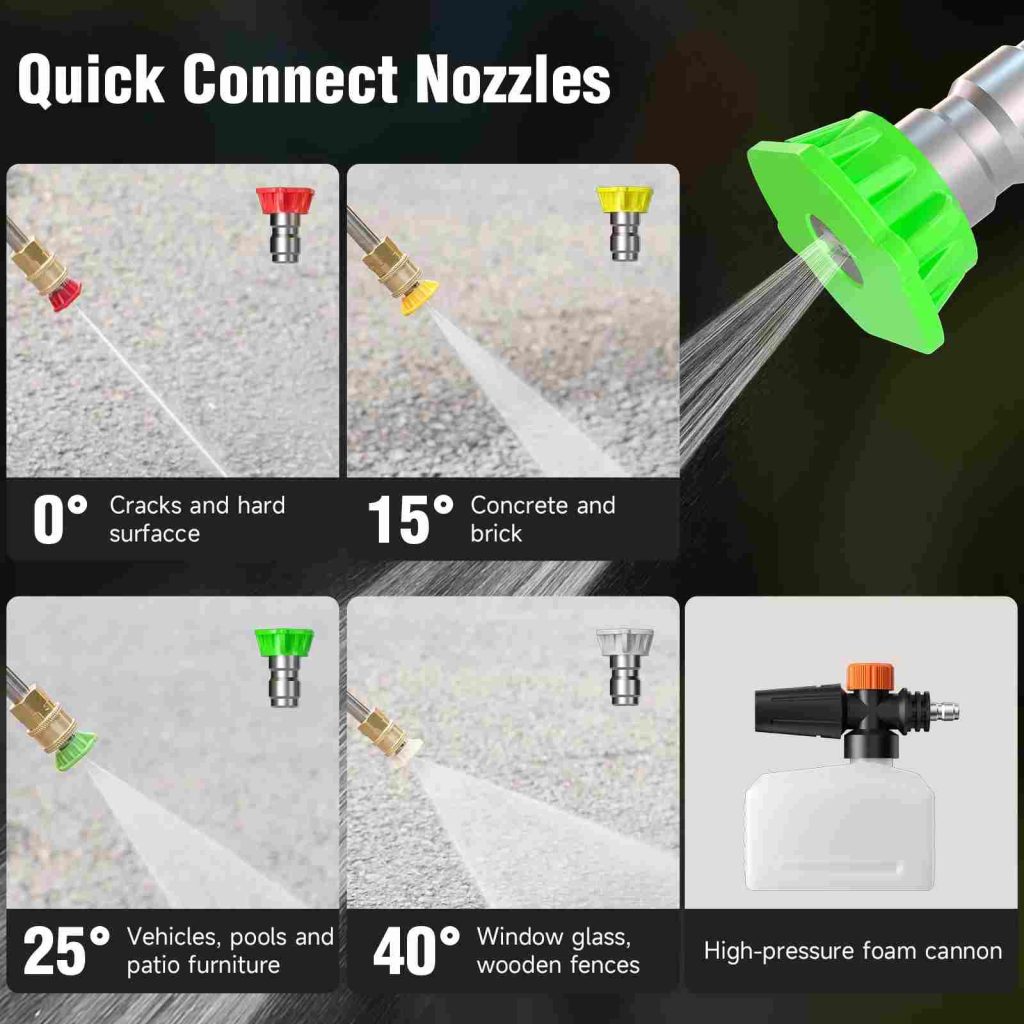
Nozzle changes directly change how hard the water hits the surface.
- 0° (red) – Never use on a driveway. It’s like a laser. It will cut lines into concrete.
- 15° (yellow) – Only for stripping paint or heavy rust. Risky on driveways.
- 25° (green) – Safe and effective for most concrete cleaning. Good balance of force and spread.
- 40° (white) – For asphalt, soft brick, or final rinsing. Low risk, but slower on thick grime.
- Soap nozzle (black) – Low pressure, used only to apply detergent.
For a dirty concrete driveway, start with the 25° nozzle. If that’s too slow, switch to 15° only on tough spots and keep the wand moving. Do not stop in one place.
What detergent works?
Don’t use the generic “pressure washer soap.” For driveways:
- Concrete-safe degreaser (for oil spots)
- Sodium hypochlorite-based cleaner (for mold and moss — dilute properly, usually 1:4 with water)
- Never use bleach straight from the bottle. It kills plants along the edge and won’t help much on concrete.
Apply detergent with the black soap nozzle. Let it sit 5–10 minutes. Don’t let it dry. Then switch to the 25° nozzle and rinse.
How to Clean Your Driveway with an Electric Pressure Washer ?
You don’t need a long routine. Just follow these steps.
1. Clear & sweep: Remove cars and debris. Sweep loose dirt.
2. Pre-treat stains: Spray oil spots with degreaser. Wait 5 minutes.
3. Set up: Plug into GFCI. Turn the water on, then the power. Test green (25°) nozzle on a small spot.
4. Wash: Hold the wand at 45°, 18–24 inches from the concrete. Start at the garage, work downhill. Overlap passes by 6 inches.
For asphalt: use a white (40°) nozzle and stay 24+ inches away.
5. Rinse & store: Rinse with white (40°) nozzle. Let dry 2 hours. Release pressure, store above freezing.
Total time: 35–50 minutes for a two-car driveway.
View more details in: How to Clean Driveway with Pressure Washer
Frequently Asked Questions
Q: Is it okay to use an electric pressure washer on a cracked and aged driveway?
Yes, but exercise caution. Apply a 40° nozzle and maintain distance (24+ inches). If pieces chip off, halt; your concrete is deteriorating.
Q: Is a surface cleaning attachment necessary?
Not required, but recommended. It halves the job duration and prevents streaking. Needs at least 1.5 GPM.
Q: Am I risking damage to my driveway?
Yes – when using a 0° or 15° nozzle too close, or standing still for too long. Begin far away, then approach gradually.
Q: Do I require a brushless motor?
No, unless you intend to use it frequently (4–6 times per year). Normal motors suffice.
Final
An electric pressure washer is a great option if you want a clean driveway without dealing with gas-engine issues.
Match the PSI (>1,900), consider the GPM (>1.4), take care of the nozzle (green 25° for concrete), and follow all the above instructions. Your driveway will be brand new, and your device will be ready to work again.