
What Is a Good Air Speed for a Leaf Blower?
Are you struggling to remove large wet leaves or a lot of dirt from your garden? Finding the ideal air speed is the key to transform your cleaning routine from a tiring chore into an effortless job. Many buyers focus solely on the numbers; an effective leaf blower is able to balance the power of its raw source with tactical rigor. Let’s look at what makes a “good” air speed for different cleaning scenarios, discover the important connection between the MPH number and CFM and find out the reasons why a tool that is versatile such as AIVOLT Cordless Leaf Blower could transform the efficiency of your garden maintenance.

Decoding the Metrics MPH Vs. CFM
When you’re shopping for leaf blowers, you’ll run into two big numbers, MPH and CFM.Knowing the difference is essential in deciding on the appropriate machine for the specific conditions you are in.
- MPH (Air Speed): This measurement determines how quickly air flows through the nozzle. Higher MPH provide the required “force” to dislodge heavy and compacted debris that has clung on the floor.
- CFM (Air Volume) : This is the amount of air moved in a minute. Imagine CFM in terms of being the “width” of your broom and a greater CFM lets you move bigger piles of dry, light grass in just one move.
The Expert’s View: A high MPH with an sufficient CFM is similar to having an extremely thin needle that’s ideal for removing cracks, but isn’t ideal for clearing the entire lawn. On the other hand, a high CFM with insufficient MPH won’t be able to move anything that is heavy or damp. A top blower has to find a way to balance both.
Your Golden Speed Guide: Choosing the Right MPH
Some garden chores don’t require a lot of power. The wrong speed could cause battery drain or worse, damage to the topsoil of your lawn and also decorative mulch.
| Task Intensity | Recommended Air Speed (MPH) | Ideal Scenario |
| Light | 60 – 100 MPH | Cleansing grass clippings and dry grass dust or small pieces of debris from driveways, patios, and walkways. |
| Medium | 120 – 150 MPH | Cleaning up fallen leaves that have dried and yard cleanup in autumn and general lawn care. |
| Heavy | 150+ MPH | Eliminating matted, wet leaves large pieces of debris, gravel scattered across the walkway. |
Why the AIVOLT Cordless Leaf Blower Sets the Standard
Knowing how to use the data is just one aspect of the battle. The second half is using the right tool that is able to adapt to your requirements. AIVOLT 40V Cordless Leaf Blower stands out in a crowded marketplace because it is able to bridge the gap between power from raw sources and user-centric engineering.
Variable Speed Control for Precision
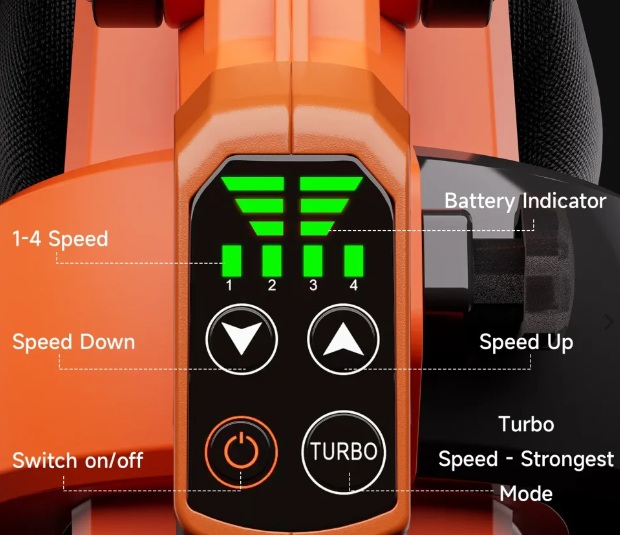
One of the biggest errors homeowners make is to use the “one-speed” blower. The Aivolt 40V blower comes with an easy-to-use variable speed trigger that allows users to immediately lower the power level when working in flower beds to keep from blowing out mulch or increase it to its maximum if you have massive piles of wet soil. This versatility is a feature of a high-performance blower.
The 40V Advantage
With typical 20V tools, you sometimes notice the power sort of fades when the battery gets low. If you go with a 40V platform, AIVOLT’s blower keeps a more steady output, so the air speed doesn’t really stall out from the very start, all the way through the job. In plain terms, you get cleaner results with less hassle and fewer pauses to recharge.
Ergonomics Meets Power
High air speed usually has a tradeoff, it can mean more mass and more buzzing vibration. AIVOLT has leaned hard into ergonomics, so even when you’re hitting top MPH, the unit stays well-balanced, easy to steer, and not overly tiring in the hands. For anyone covering big yards or large properties, this comfort factor matters just as much as the MPH number itself.
Factors That Influence Your Blower’s Real-World Efficiency
Aside from whatever the manufacturer claims on the spec sheet, there are also couple other things that really decide how “quick” the blower feels in actual use:
The Nozzle Style
A lot of higher end blowers ship with various nozzle attachments. When you use a tapered , sort of concentrated nozzle, it pushes air faster (MPH), so it’s good for brushing out debris from cramped little corners or shifting heavier gravel. On the flip side, a wide mouth nozzle is more about raw output (CFM), which tends to work better on wider, open lawn zones.
Battery Condition and Chemistry
Running a lithium ion setup like the AIVOLT 40V helps it hold near its best performance for longer stretches. With older or lower grade batteries you can get “voltage sag”, basically the air speed dips in a very noticeable way as the battery runs down. Solid battery technology is sort of the “engine” behind steady leaf blower speed, not just the power level.de stripping power to erase years of baked-on tree sap and black mold in a single pass—all with the hassle-free, push-button ease of a reliable electric motor.
Choosing the Right Tool for Your Yard
Finding a “good” air speed isn’t just about picking the biggest number on the label. It’s more about the weird little balance between speed (MPH) and volume (CFM), then matching that capability to what your property is actually doing—trees, paths, stubborn grit, you know. A system that looks powerful on paper still has to behave in real life.
If you’re done with machines that feel weak as soon as morning dew shows up, or when heavy fall buildup starts stacking up, it might be time to switch to something built for flexibility. With the AIVOLT 40V Cordless Leaf Blower, you get pro-style air speed control, strong power consistency, and that comfortable, easy-to-hold design that helps you push through any yard task with a lot less doubt.
So, ready to steal back your weekend from endless cleanup? Head to AIVOLT today, and take a look at how the AIVOLT 40V setup can turn your own backyard into a space you can handle like a professional.